
Strategic Advisory · Your Wingman

Biomimicry
Founder's Diary
Author: Stefan Esser
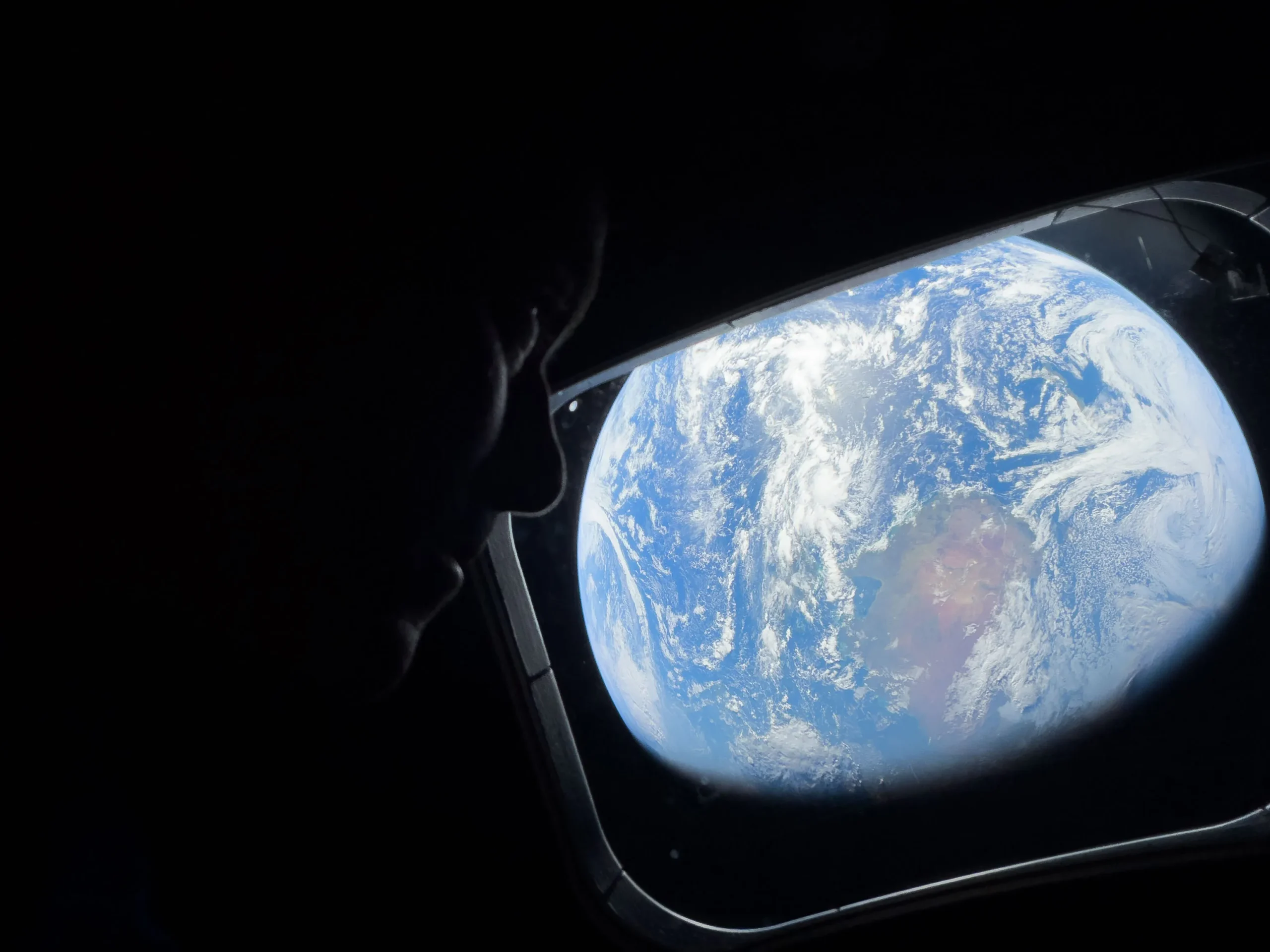
A few days ago, as the Artemis II astronauts were on their way to the Moon, pilot Victor Glover was answering a question from CBS News. He had nothing prepared. But he said this: “You guys are talking to us because we’re in a spaceship really far from Earth, but you’re on a spaceship called Earth that was created to give us a place to live in the universe.”
Today is Earth Day. And that sentence strikes me as the best possible starting point for reflection.
When Glover compared Earth to a spaceship, it sounded like poetry. But it was also physics.
Right now, as you read this, you’re spinning on Earth’s axis at 1.674 km/h at the equator. At the same time, you’re travelling with Earth around the Sun at 107.000 km/h. Together with the Solar System, you’re moving around the centre of the Milky Way at at least 720.000 km/h.
And the Milky Way itself, along with its cosmic surroundings, is hurtling through the universe at over 2.100.000 km/h… towards what? Towards an immense concentration of mass that astronomers call the Great Attractor, more than 200 million light-years away.
“… Oh, right, cool… could you pass the salt, please?”
You don’t notice it. You don’t have to do anything for it to happen. The ship runs itself.
What strikes me about that image isn’t the speed. It’s everything that comes included with the ship and the ticket: water, oxygen, regulated temperature, nutrient cycles, recycling systems, biodiversity, pollinators, living soils. None of this is manufactured elsewhere. It’s all produced and regenerated here, aboard the same ship, in a closed system of exquisite complexity.
The ship came equipped for a very long journey. And it still is. The problem is that we’ve spent decades consuming its resources as if, somewhere along the way, we’d find a refuelling station.
Nature has spent 3.8 billion years perfecting how this ship works. Organisms that failed to adapt, regenerate and close their resource cycles disappeared. Those that survived found solutions that worked over the long term, without generating waste or depleting the system.
That’s biomimicry: learning FROM nature, not about it, to emulate its solutions and address human problems in more sustainable ways. And something more: a process that reconnects us with the non-human world and reminds us that we are one species among millions, also capable of designing conditions that are conducive to life.
In biomimicry, there is a set of principles that nature appears to follow universally. They’re called Life’s Principles: 26 patterns, grouped into 6 clusters, that every living thing integrates in order to survive and thrive under the conditions of this planet. They are not a list of good intentions, but strategies tested over billions of years, which we can translate into the language of design. (A dedicated post on this coming soon.)
The ship came with instructions. Written across 3.8 billion years of trial and error. The problem isn’t that the instructions are illegible. It’s that we’ve barely started reading them.
The first Earth Day was on 22 April 1970. It was driven by US Senator Gaylord Nelson and a young activist named Denis Hayes, who deliberately organised it to fall in the window between spring break and final exams, the moment when students are on campus but their schedules are still open. That day, twenty million people took to the streets across the United States. In 1990, Hayes took it global, reaching 141 countries. It wasn’t until 2009 that the United Nations formally recognised it as an International Day. Today, more than one billion people mark it in 193 countries.
This year’s theme is Our Power, Our Planet: environmental progress doesn’t depend on any government or any election. It depends on what each of us does every day, in the place where we live and work.
It’s a message that resonates especially in the moment we’re living through.
Today Create361 turns two. I signed the articles of incorporation on 22 April 2024 – Earth Day, and the day after World Creativity and Innovation Day – as a statement of intent: a project that exists to build bridges between the proven wisdom of ecosystems and the most powerful technologies of our time, for a thriving planet and society.
It will be quite a challenge to build the reach I imagine. The founding conviction remains the same: the problem isn’t a lack of solutions. It’s a lack of connections.
The ship came fully equipped. With the best engineers that have ever existed: 3.8 billion years of evolution. What we’re missing is reading the manual with the attention it deserves.
If nature creates conditions conducive to life, don’t you think that emulating it could inspire you to move towards truly sustainable development for your business?
Photo: NASA · “Thinking of You, Earth” · Artemis II, April 4, 2026. Commander Reid Wiseman looks back at Earth through one of the Orion spacecraft’s cabin windows, on the way to the Moon. The following day, his crewmate Victor Glover would describe that same Earth as “a spaceship called Earth, created to give us a place to live in the universe.”

Comentarios
0 comentarios
Todavía no hay comentarios. Sé el primero en participar.